
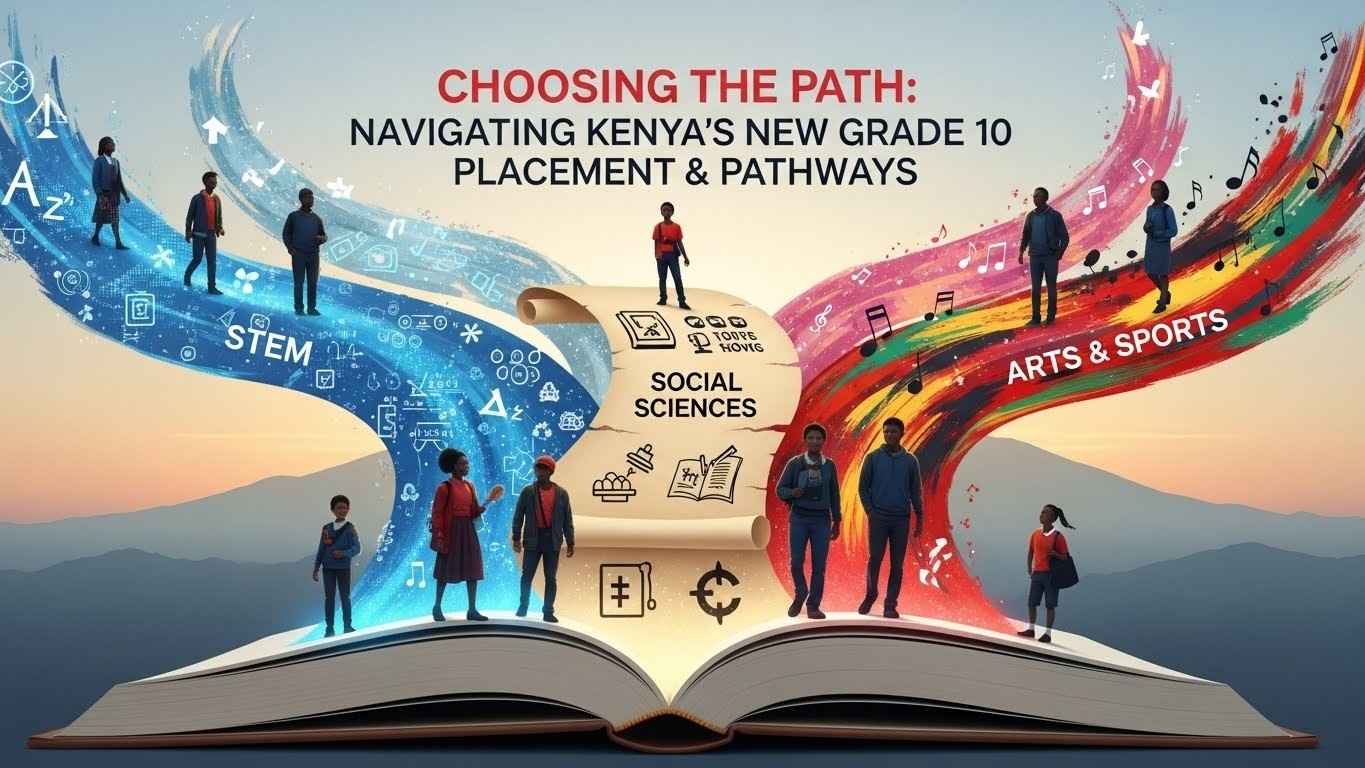

The new grade 10 school placement and pathways system marks a historic shift in Kenyan education. If you are a parent, Grade 9 learner, or educator, the word “placement” has likely caused some anxiety. This blog breaks down everything you need to know about this pioneering Competency-Based Curriculum (CBC) transition, where learners are no longer placed simply by exam scores but are guided into pathways that shape their future.
What Does Grade 10 School Placement and Pathways Involve?
- It is Kenya’s new CBC system for transitioning learners to senior school.
- Places students based on KJSEA scores, learner choices, and school capacity.
- Assigns one of three pathways: STEM, Social Sciences, or Arts & Sports Science.
- Uses a holistic, automated system that considers performance, teacher input, and student interest.
- Moves beyond the old KCPE model to a strength-based, career-oriented education.
Background
The transition from junior to senior school under Kenya’s Competency-Based Curriculum (CBC) represents the most significant educational reform in a generation. For over 1.13 million pioneer Grade 9 learners, the newly announced grade 10 school placement and pathways system is not just an administrative process—it’s a fundamental reimagining of how education aligns with individual talent, interest, and future aspiration.
The Paradigm Shift – From Uniform Placement to Personalized Pathways
Gone are the days when a single national exam score dictated a learner’s secondary school destiny. The old 8-4-4 system’s KCPE placement was largely a linear process: higher scores led to higher-tier national schools. The new grade 10 school placement and pathways model, however, is multidimensional.
The Core Philosophy: This system recognizes that intelligence and potential are not one-dimensional. A learner passionate about engineering has a different academic journey from one gifted in the arts or one adept in economics. The CBC senior school structure is designed to nurture these distinct aptitudes from Grade 10 through Grade 12, ensuring education is relevant and engaging.
The Ministry of Education, through Cabinet Secretary Ogamba, has emphasized that this process is “learner-centered.” Placement is not something that merely happens to students; it is a guided process that incorporates their performance, their expressed interests, and the professional insights of their teachers.
Deconstructing the Three Senior School Pathways
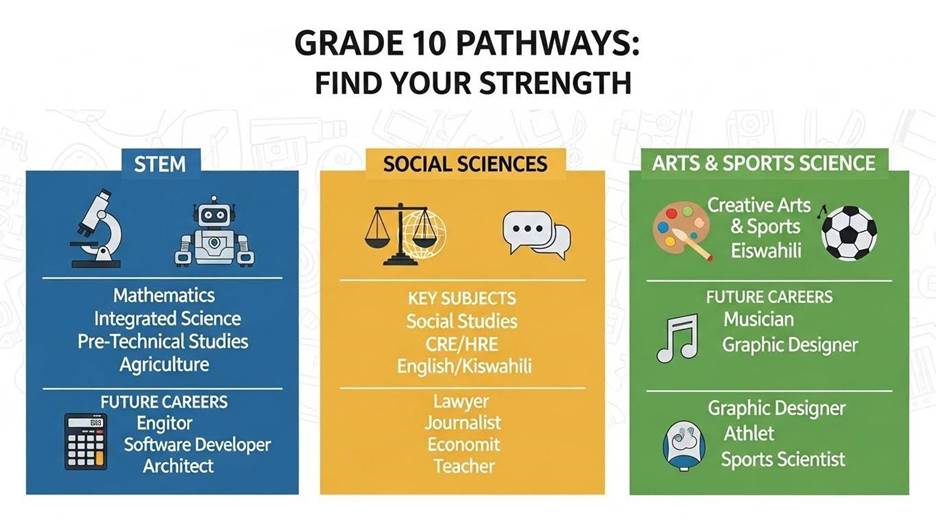
At the heart of the new grade 10 school placement are the three pathways. Each pathway consists of a tailored combination of subjects designed to build foundational knowledge for specific career clusters.
1. The STEM Pathway (Science, Technology, Engineering, and Mathematics)
- Focus: For learners with strong analytical, problem-solving, and investigative skills.
- Career Directions: Medicine, Engineering, Architecture, Computer Science, Pure Sciences (Physics, Chemistry), Mathematics, and Technology fields.
- Subject Emphasis: The pathway qualification heavily weighs Mathematics, Integrated Science, Pre-Technical Studies, and Agriculture.
- The Numbers: This is the most popular pathway, selected by over 600,000 of the pioneer candidates, indicating a strong alignment with global and national economic priorities.
2. The Social Sciences Pathway
- Focus: For learners interested in human systems, societies, communication, and commerce.
- Career Directions: Law, Journalism, Economics, Business Management, Education, Psychology, Political Science, and International Relations.
- Subject Emphasis: Qualification is based on performance in Social Studies, Christian Religious Education (CRE)/HRE, and either English or Kiswahili.
- The Numbers: A substantial 437,000 learners have shown interest in this pathway, which forms the backbone of the humanities and social services sectors.
3. The Arts and Sports Science Pathway
- Focus: For the creatively inclined and athletically gifted, emphasizing talent development.
- Career Directions: Music, Theatre, Film, Visual Arts, Dance, Sports Management, Athletics, and Design.
- Subject Emphasis: Scores in Creative Arts and Sports, English, and Kiswahili determine eligibility, highlighting the importance of communication in creative expression.
- The Numbers: About 124,000 learners opted for this pathway, affirming the system’s commitment to valuing and formalizing talent-based education.
The Step-by-Step Placement Mechanism
Understanding the grade 10 school placement process demystifies it. Here’s how it works, step by step:
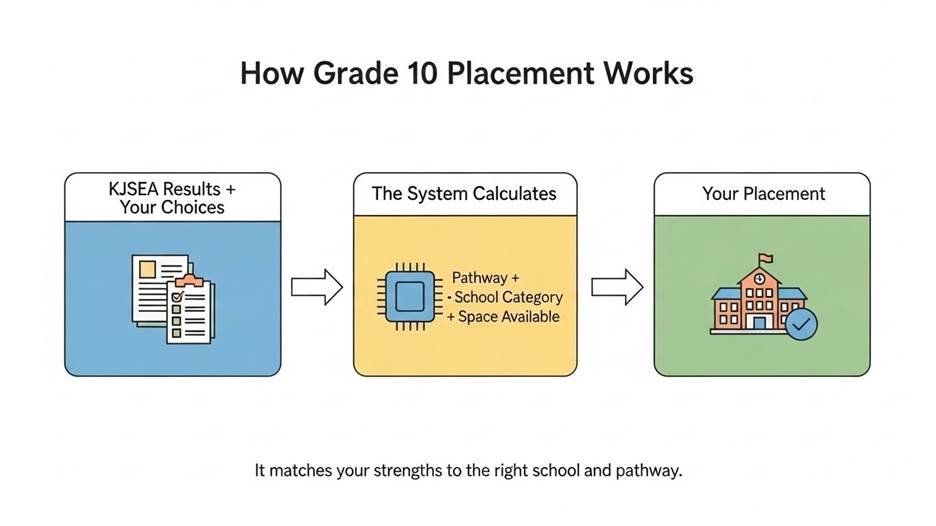
Step 1: The Foundation – KJSEA Performance
The Kenya Junior School Education Assessment (KJSEA) provides the primary academic data. However, it is not the sole determinant. The total score (1-72 points) places a learner into a school category:
- 61-72 points: Category 1 (National Schools)
- 41-60 points: Category 2 (Extra County Schools)
- 21-40 points: Category 3 (County Schools)
- 1-20 points: Category 4 (Sub-County Schools)
Step 2: Pathway Eligibility Calculation
As detailed above, KNEC uses z-scores from specific subject clusters to calculate a learner’s strength in each pathway. A learner can qualify for one, two, or even all three pathways.
Step 3: The Crucial Role of Learner Choices
Before the exams, each Grade 9 learner submitted a selection of 12 schools for their preferred pathway. This choice is a critical input. The automated placement system first looks to match a learner with their highest-preference school that has capacity and for which they meet the criteria.
Step 4: The Priority Placement Matrix
Within each school category and county/sub-county, a priority system is applied:
- STEM: Top 6 learners per gender, per track, get boarding priority.
- Social Sciences: Top 3 learners per gender, per track, get boarding priority.
- Arts & Sports: Top 2 learners per gender, per track, get boarding priority.
This ensures merit within a pathway is recognized locally.
Step 5: The Distribution Formula
To ensure national equity, the ministry used the County Revenue Allocation Formula to distribute learners across schools. This prevents overcrowding in some regions and under-enrollment in others.
Critical Practical Information for Parents and Learners
Checking Placement Results
Results are accessed via:
- SMS: Send your candidate’s index number to a designated ministry code.
- Online Portal: Visit placement.education.go.ke and enter the required details.
The Golden Rule: Do Not Rush the Download
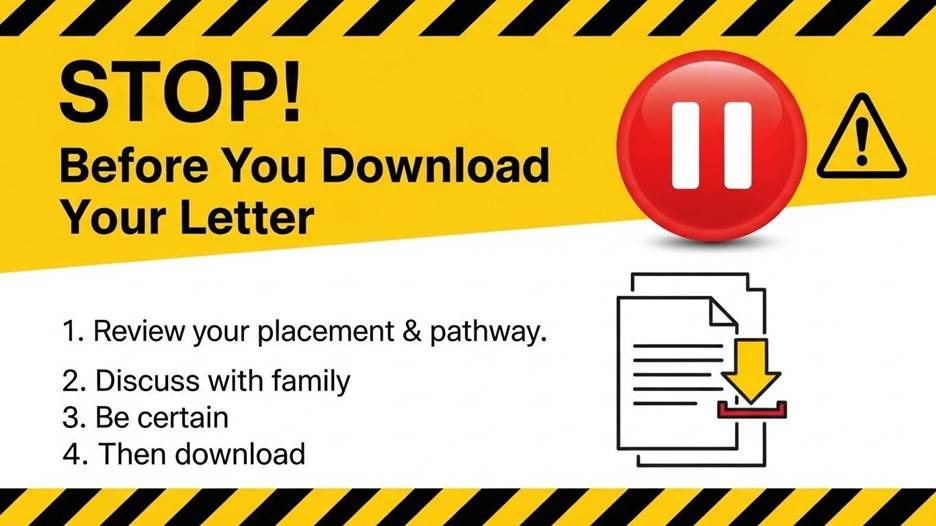
When you see the placement, DO NOT immediately download the admission letter. Downloading is interpreted as formal acceptance of that placement. First, review the school and pathway carefully with your child. If satisfied, then proceed to download.
The Replacement Process (Think Carefully!)
If a change is desired, the only official channel is through the headteacher of the former junior school. The process is strict:
- Requests must be made at least two weeks before the reporting date (January 12, 2026).
- Replacement is based on documented vacancies in schools.
- Priority is given to learners who had initially selected the school they are requesting.
- This process is done ONLY ONCE and is IRREVERSIBLE. Choose wisely.
Looking Ahead – Capacity, Technology, and the Bigger Picture
Is there enough space? Yes. With 9,540 public senior schools having a capacity for 2.2 million learners against 1.13 million candidates, and with the exit of the 8-4-4 final class, there is adequate and even excess capacity to ensure a smooth transition.

The Technology Backbone: A sophisticated automated system processes millions of data points—teacher insights, academic scores, and student interest forms—to make placements. This technology ensures transparency, minimizes human bias, and allows for efficient management of the colossal task.
Final Remarks
The new grade 10 school placement and pathways system is more than an administrative change; it is a cultural shift in how Kenya views success and potential. It tells learners, “Your unique strengths matter.” It prepares them not just for exams, but for the world of work and innovation.
To the pioneering class of 2024: you are making history. Embrace your pathway, engage deeply with your chosen subjects, and own your educational journey. To the parents and guardians: your support in understanding this complex but promising system is invaluable. Guide your children to see this not as an end, but as the exciting beginning of a tailored journey toward their future.