

How to Make Money Online in Kenya: 10 Proven Methods That Actually Pay
Learning how to make money online in Kenya can transform your financial future — whether you’re a student, job-seeker, or entrepreneur looking to break free from the 9-to-5. Here are the most trusted, real-earning methods available to Kenyans right now.

How to make money online in Kenya:
The top ways include freelancing on Upwork or Fiverr, starting a blog, affiliate marketing, creating YouTube content, selling digital products, online tutoring, and taking remote jobs. Most methods cost nothing to start and pay via M-Pesa, Payoneer, or Wise.
Kenya’s Digital Economy — Why the Time Is Now
Understanding how to make money online in Kenya has never been more relevant than it is today. With over 30 million internet users, one of Africa’s highest mobile penetration rates, and the world-class M-Pesa mobile money ecosystem, Kenya is uniquely positioned for its citizens to tap into a global digital economy — without ever leaving their county.
The barriers that once blocked Kenyans from global income — unreliable payments, poor connectivity, limited platforms — have crumbled. International payment platforms like Payoneer and Wise link directly to M-Pesa. Affordable data bundles mean rural Kenyans can compete with freelancers in London and New York. And AI tools have compressed the time it takes to deliver professional-grade work, meaning you can do more in fewer hours.
This guide covers the 10 most reliable and high-earning methods to make money online in Kenya in 2026 — each one with real income figures, the best platforms to use, and honest advice on how long it takes to see results.
1. Freelancing on International Platforms
🖥️ Freelancing
Freelancing is the single most popular and scalable way to make money online in Kenya. You offer a skill — writing, graphic design, web development, video editing, virtual assistance, data entry, SEO, social media management — and get paid per project or on retainer by international clients.
The Kenyan edge here is enormous: you compete on the same platforms as global talent, but your cost of living is a fraction of a Western freelancer’s, allowing you to offer competitive rates while still earning a life-changing income locally.
Top skills in demand in 2026: Web development (React, WordPress), video editing, AI prompt engineering, data analysis (Python/SQL), graphic design (Figma, Adobe Suite), copywriting, and UI/UX design.
Upwork is generally considered the best platform for high-paying clients, while Fiverr is more beginner-friendly because clients come to you rather than the other way around. Start on one platform, build your profile with strong samples and reviews, and never switch until you have a steady income.
2. Online Writing & Copywriting
✍️ Online Writing
Freelance writing remains one of the most accessible ways to make money online in Kenya, requiring no capital and no degree — only strong writing ability and the willingness to meet deadlines. Opportunities range from blog posts and website copy to academic writing, technical documentation, email marketing, and product descriptions.
Kenyan writers with strong profiles on Upwork can earn $50–$200 per article when working with premium international clients. Beginners can start with content mills like Textbroker or iWriter (Ksh 200–500 per article) to build a portfolio before moving to direct clients.
Read More
Freelance Writing Jobs in Kenya: Top 5 in 2026
3. Blogging & Website Monetisation

🌐 Blogging
Blogging is one of the most underrated ways to make money online in Kenya. It is slow to start — expect 3–6 months before meaningful earnings and 6–12 months for consistent income — but once a blog is ranking on Google, it earns money 24/7 without your active involvement.
Monetisation channels include Google AdSense (display ads), affiliate marketing (earn commission on recommended products), sponsored posts, and selling your own digital products or services. Niches with the highest Kenyan RPM (revenue per thousand readers) include personal finance, technology, travel, and health.
In 2026, GEO (Generative Engine Optimisation) — optimising content to appear in AI search summaries from tools like ChatGPT, Gemini, and Claude — is an emerging skill with almost zero competition in Kenya right now. Bloggers who learn it early will dominate.
Step-by-Step Guide
How to Start a Blog in 2026: From Zero to Published in a Day
4. Affiliate Marketing
🔗 Affiliate Marketing
Affiliate marketing means promoting other companies’ products and earning a commission — typically 5%–50% — every time someone buys through your unique link. You don’t hold inventory, handle shipping, or deal with customer service. Your only job is driving the right audience to the right product.
For Kenyans, the best affiliate programmes to start with are Jumia KOL (up to 11% commission on electronics and fashion), Amazon Associates (targeting international audiences), and ClickBank / ShareASale for digital products with commissions as high as 75%.
The most effective distribution channels are a blog (evergreen SEO content), a YouTube channel, a WhatsApp group, or a well-followed social media account. Affiliate marketing only works when you genuinely help people make decisions — spamming links without context earns nothing.
5. YouTube & TikTok Content Creation

🎬 YouTube & TikTok
YouTube is a long-term play. You won’t earn in the first few months, but once you hit the 500-subscriber / 3,000-watch-hour threshold, YouTube AdSense kicks in. From there, income can snowball via brand deals, affiliate links embedded in video descriptions, channel memberships, and merchandise.
Kenyan channels performing well include personal finance, tech reviews, comedy, and diaspora-targeted content. TikTok’s Creator Fund pays, but brand sponsorships — once you have a genuine audience — pay far more. AI video tools in 2026 have dramatically reduced production barriers, meaning even a smartphone can produce content that attracts millions of views.
6. Selling Digital Products
📦 Digital Products
A digital product is created once and sold unlimited times — no inventory, no shipping, no restocking. Popular formats include eBooks, online courses, design templates, CV templates, Canva graphics, Notion dashboards, and photography presets.
For Kenyan creators, Selar is the leading platform — it accepts M-Pesa and international cards, has built-in affiliate tools, and is designed for African markets. NipeDigital is another Kenya-specific marketplace that accepts Airtel Money, M-Pesa, and card payments.
7. Online Tutoring & Teaching
🎓 Online Tutoring
If you’re academically strong — whether in mathematics, sciences, English, or a professional skill — you can teach students around the world from your home. Platforms like Preply and iTalki connect tutors with language learners globally, while Chegg Tutors and Wyzant focus on academic subjects.
Kenyan tutors teaching English to learners in Japan, South Korea, and Europe typically earn between $10–$25 per hour. Subject tutors in STEM fields can charge even more. The demand for native or near-native English speakers from Africa is growing rapidly.
8. E-Commerce & Dropshipping
🛒 E-Commerce
E-commerce in Kenya is booming. You can sell physical products through Jumia, Jiji, or your own Shopify/WooCommerce store — or through Instagram and WhatsApp Business, which are increasingly effective Kenyan sales channels.
Dropshipping is a popular zero-inventory model where you market products and pass orders directly to the supplier, who ships to the customer. While margins are thinner, the capital requirements are near zero. For those with capital to start a small business, check our dedicated guide below.
Related Guide
Businesses to Start with Ksh 50,000: Top 10 Options in 2026
9. Remote Employment
💼 Remote Jobs
Unlike freelancing, remote employment means a stable monthly salary from a foreign or Kenyan company — with the security of employment but the freedom of working from home. In-demand roles include customer support, virtual assistant, software developer, data analyst, digital marketer, and product manager.
Kenya’s tech-savvy workforce and English proficiency make Kenyans highly competitive for global remote roles. Sites like Remote.co, We Work Remotely, LinkedIn Remote Jobs, and Andela (which specifically recruits African tech talent) are the best places to search.
10. Micro-Tasks, Surveys & Data Annotation
⚙️ Micro-Tasks
Micro-task platforms are the fastest way to earn your first money online in Kenya — but they have a low earnings ceiling. Tasks include image labeling, data annotation for AI training, audio transcription, and short surveys. Some Kenyan users report their first payment within 24–72 hours.
Treat these as a starter method only. Use the modest income and experience to build confidence, then pivot to a higher-earning skill like freelancing or content creation as quickly as possible.
How to Receive Online Payments in Kenya
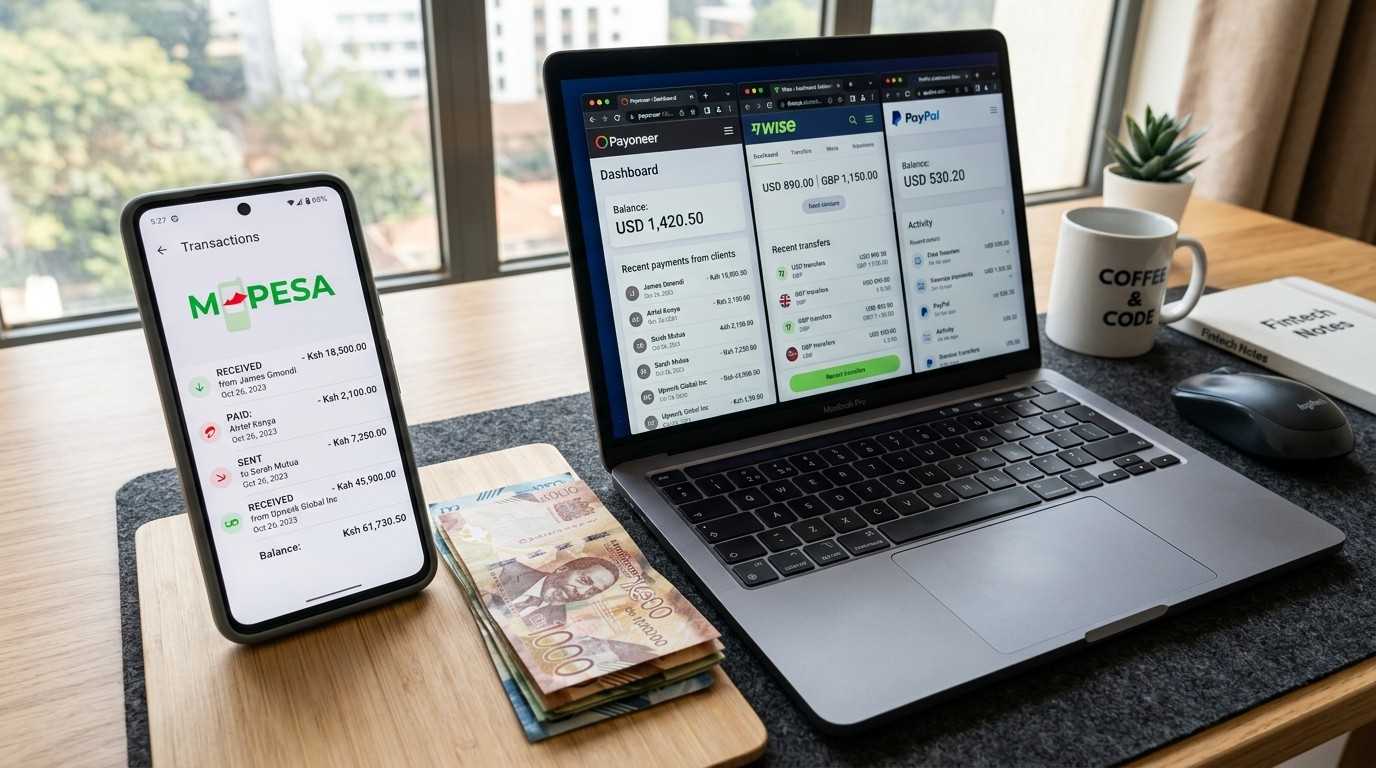
One of the most common questions from Kenyan online earners is: how do I actually get the money? The good news is that in 2026, receiving international payments in Kenya is straightforward and cheap.
💚 Payoneer
Best all-around option. Links directly to M-Pesa. Accepted by most freelance platforms including Upwork and Fiverr.
Fee: ~$2–$3 flat withdrawal
🔵 Wise
Best exchange rates. Ideal for receiving payments in USD, GBP, or EUR and converting to KES.
Fee: ~0.5–1% of amount
💳 PayPal
Widely accepted but higher withdrawal fees in Kenya. Use Flutterwave to bridge PayPal to M-Pesa.
Fee: ~4.4% + fixed fee
📱 M-Pesa
Final destination for most Kenyan earners. Many platforms now pay directly to M-Pesa via M-Pesa Global.
Fee: Varies by amount
Realistic Earnings Comparison Table
The figures below are realistic ranges based on typical Kenyan earners in 2026. Your results will depend on skill level, consistency, and the time invested.
| Method | Monthly Earning (Ksh) | Time to First Pay | Difficulty | Capital Needed |
|---|---|---|---|---|
| Freelancing | 10,000 – 500,000+ | 2–6 weeks | Medium | Ksh 0 |
| Online Writing | 15,000 – 200,000 | 1–3 weeks | Low–Medium | Ksh 0 |
| Blogging | 5,000 – 300,000 | 6–12 months | Medium–High | Ksh 3,000–10,000 |
| Affiliate Marketing | 10,000 – 400,000 | 3–6 months | Medium | Ksh 0–5,000 |
| YouTube / TikTok | 0 – 500,000+ | 6–12 months | High | Ksh 0–20,000 |
| Digital Products | 20,000 – 300,000 | 1–4 months | Medium | Ksh 0 |
| Online Tutoring | 15,000 – 150,000 | 1–3 weeks | Low | Ksh 0 |
| E-Commerce | 20,000 – 500,000 | 2–8 weeks | Medium–High | Ksh 5,000–50,000 |
| Remote Employment | 60,000 – 400,000 | 4–12 weeks | High | Ksh 0 |
| Micro-Tasks / Surveys | 2,000 – 15,000 | 24–72 hours | Very Low | Ksh 0 |
How to Spot & Avoid Online Scams in Kenya
The growth of online income opportunities in Kenya has unfortunately attracted scammers. Here are the most reliable red flags to watch for:
Stick to platforms with verifiable reviews on Trustpilot and established international reputations. If something feels too good to be true, it almost always is. The Directorate of Criminal Investigations (DCI) regularly warns Kenyans about new online fraud schemes — follow their social media pages to stay updated.
Frequently Asked Questions
Can I make money online in Kenya without any skills or capital?
Yes — micro-task platforms like Remotasks and Appen require no capital and minimal skills. However, these platforms pay modestly (Ksh 2,000–10,000/month). Treat them as a starting point while you simultaneously develop a marketable skill like writing, design, or web development.
What is the fastest way to make money online in Kenya?
Micro-task platforms pay within 24–72 hours of starting. Selling items on Jiji or Facebook Marketplace can also generate income within hours. For sustainable income, freelancing on Fiverr typically produces a first payment within 2–4 weeks for those with marketable skills.
How do I receive international online payments in Kenya?
Payoneer and Wise are the most cost-effective options for Kenyan earners. Both can link to M-Pesa for local withdrawals. Payoneer charges a flat ~$2–$3 fee; Wise charges 0.5–1% with the best exchange rates available. PayPal is also widely accepted but has higher fees.
Is online income in Kenya taxable?
Yes. Online income earned by Kenyan residents is subject to income tax under the Kenya Revenue Authority (KRA) guidelines. Digital service taxes apply to foreign platforms operating in Kenya, and individual online earners are expected to declare income through their iTax accounts. It is advisable to consult a tax professional as your income grows.
How much can a Kenyan beginner realistically earn online per month?
Beginners using micro-tasks or entry-level writing can expect Ksh 5,000–20,000 in the first month. Within 3–6 months of consistent effort on freelancing platforms, Ksh 40,000–100,000 per month is achievable. Experienced professionals in web development or video editing can exceed Ksh 200,000–500,000 per month.
What skills are most in demand for making money online in Kenya in 2026?
The highest-paying skills in 2026 are web development (React, WordPress), video editing, AI prompt engineering, data analysis (Python/SQL), UI/UX design, copywriting, and digital marketing. GEO (Generative Engine Optimisation) is an emerging skill with very little competition in Kenya right now.