If you want to rank on Google in Kenya, you do not need a big budget, a fancy degree, or a secret trick. You need a clear plan and a little patience.
Think of Google as a giant library. Every second, people walk in and ask questions. Google's software is the librarian, and it points each person to the best book on the shelf. Your job is to write a page so helpful that the librarian picks it first.
Kenyans are already asking. StatCounter shows Google handling more than 96 out of every 100 searches in Kenya, and DataReportal counted 77.5 million mobile connections here in late 2025. People type "ex-UK laptops in Nairobi" or "how to apply for a HELB loan" first, and then they buy, learn, or apply.
This guide walks you through every step, from finding keywords to earning links, in plain English. Do you not have a website yet? Read our guide on how to start a blog like a professional first, then come back here.
- 96%+ of searches in Kenya go through Google, according to StatCounter.
- 77.5 million mobile connections were active in Kenya in late 2025, says DataReportal.
- 2.5 seconds is the "good" loading time Google wants for your main content. See Step 4.
How Do You Rank on Google in Kenya?
To rank on Google in Kenya, pick a keyword Kenyans search for, write a helpful page that answers it fully, and make your site fast on phones. Then add clear titles, local details, and links from trusted sites. Keep improving your pages so they stay helpful and trusted over time.
Here are the eight steps in one look. Each one has its own section below.
- Find keywords Kenyans really search.
- Write content that helps people.
- Tune each page with a good title, address, and description.
- Make your site fast and easy to use on a phone.
- Set up Google Business Profile to win local searches.
- Earn trust with links from other good websites.
- Write direct answers so Google and AI tools can quote you.
- Track your results and keep improving.
Jump to a section
- How Google finds and ranks your page
- What makes search in Kenya different
- Step 1: Find keywords
- Step 2: Write helpful content
- Step 3: Tune each page
- Step 4: Speed and mobile
- Step 5: Local SEO
- Step 6: Backlinks
- Step 7: Answer engines (AEO)
- Step 8: Track results
- SEO mistakes to avoid
- What SEO costs in Kenya
- Your 30-day action plan
- Frequently asked questions
- Key takeaways
How Google Finds and Ranks Your Page
Before you fix anything, learn how Google works. It does three jobs, always in this order.
-
Job 1: Crawl
A Google robot follows links from page to page, like a person walking from shop to shop. If no link leads to your page, the robot may never find it.
-
Job 2: Index
Google reads the page and saves it in a giant list. Pages that are broken, very slow, or copied from others may not get saved.
-
Job 3: Rank
When someone searches, Google picks the saved pages that best match the question and puts them in order.
Type site:yourwebsite.co.ke into Google, using your own address. If pages appear, Google has saved your site. If nothing appears, do not panic. New sites can take days or weeks to show up. Adding your site to Search Console (Step 8) helps.
What Makes Search in Kenya Different?
The basics are the same everywhere, but Kenyan searchers have their own habits. Keep these five in mind as you build your pages.
- Phones come first. Many Kenyans go online mainly on a phone, so every page must load fast and read well on a small screen.
- Data costs money. Heavy pages waste bundles. Light, fast pages earn trust and return visits.
- Places matter. People add towns and estates to their searches, such as "plumber in Nakuru" or "wedding photographer in Kisumu".
- Languages mix. Searchers may use English, Swahili, Sheng, or a mix. Test how your customers really type.
- Chat closes the sale. Many buyers want to ask a question on WhatsApp or call before they pay with M-Pesa. Make that easy on every page.
The good news is that SEO is one of the cheapest ways to get steady visitors. For more low-cost ideas beyond Google, see our guide on marketing on a budget in Kenya.
Step 1: Find Keywords Kenyans Really Search
A keyword is the word or phrase a person types into Google. The phrase in this guide's title, "rank on Google in Kenya", is one. Pick words your reader actually uses, not fancy words. Here are four free ways to find them:
- Google autocomplete. Type the start of a phrase and watch what Google suggests.
- People also ask. These question boxes in the results show real questions from real people.
- Related searches. Scroll to the bottom of the results page for more ideas.
- Search Console. Once your site is live, this free tool shows the exact words people used to find you.
Start with long keywords
Short keywords like "laptops" are crowded with big shops. Longer ones like "ex-UK business laptops in Nairobi under Ksh 40,000" have fewer competitors and clearer buyers. New websites should start long and grow from there.
Match what the person wants
Google tries to guess why someone is searching. This is called search intent. Write the kind of page that fits it.
| What the person wants | Example search in Kenya | Best page to write |
|---|---|---|
| To learn something | how to apply for HELB loan | A step-by-step guide with a short answer at the top |
| To compare options | best business laptops in Kenya | A list with prices in Ksh, pros, and cons |
| To buy now | buy HP EliteBook Nairobi | A product page with price, photos, and a WhatsApp button |
| To find a nearby business | plumber in Nakuru | A location page plus a Google Business Profile |
Use one main keyword for each page. If two pages chase the same keyword, they end up competing with each other.
Write down ten questions your customers ask you on WhatsApp or in person. Each question can become a page or a section. These are real searches in your own words.
Step 2: Write Content That Helps People
Google says its ranking systems try to show helpful, reliable pages that were made for people, not pages made only to trick search engines. Its people-first content guide even gives you questions to grade your own pages honestly.
Google also talks about four qualities called E-E-A-T. Use them as a checklist:
- Experience
- Have you used or done what you write about? Show real photos, real prices, and real results.
- Expertise
- Do you know the topic well? Explain it simply and correctly.
- Authoritativeness
- Do other people mention, quote, or link to you?
- Trust
- Is the page honest and easy to check? Show who wrote it, when it was updated, and how to contact you.
Writing rules that work
- Answer the question in the first two or three sentences. Then explain.
- Use short sentences and everyday words. If a 12-year-old can follow it, a busy adult on a matatu can too.
- Add real Kenyan examples, with prices in Ksh, names of places, and clear steps.
- Use headings so people can skim.
- Never copy other sites. Share something new from your own experience.
- Show the author and the date, and update old pages.
How long should a page be? As long as it takes to answer the question fully. There is no magic word count.
Weak opening
"Laptops are very important in today's world, and many people need them for many reasons."
Strong opening
"A good ex-UK business laptop in Nairobi costs about Ksh 20,000 to Ksh 70,000, depending on the model, memory, and screen."
The strong opening gives a number, a place, and a clear answer. Readers stay, and Google can understand it.
Helpful content can also pay you. Learn how in our guide on how to make money as a content creator in Kenya.
Step 3: Tune Each Page (On-Page SEO)
On-page SEO means the small changes you make on the page itself. Look again at the search result at the top of this guide. You control three parts of it.
- The page address (URL)
- Keep it short and use words, not codes. Join words with hyphens, like /how-to-rank-on-google-in-kenya/.
- The title
- Aim for about 60 characters. Put the keyword near the front and make people want to click. Google may sometimes rewrite a title.
- The meta description
- Aim for about 150 to 160 characters. Use the keyword once and promise a clear benefit. Google may choose different text, but a good description still helps.
Here is how a laptop seller in Nairobi might write both:
<title>Ex-UK Business Laptops in Nairobi: Prices from Ksh 20,000</title>
<meta name="description" content="Compare ex-UK HP, Dell and Lenovo laptops in Nairobi. See prices in Ksh, what to check before you buy, and how to order on WhatsApp.">
Your on-page checklist
- One H1 heading that matches the topic.
- The main keyword in the first sentence, used naturally.
- Clear H2 and H3 headings, written as questions where it helps.
- Image descriptions (alt text) that say what is in the picture, such as "shop owner checking Google on a phone in Nairobi".
- Links to your own related pages, using clear words instead of "click here". Google finds pages by following links, so this helps a lot.
- The author's name, the date, and a way to contact you.
- Structured data (called schema) such as Article and FAQ. It helps search engines understand your page, though it does not promise special results.
Step 4: Make Your Site Fast and Mobile-Friendly
A slow page makes people leave. Google checks page experience with three tests called Core Web Vitals, and it uses real visitors' data to judge them.
| Test | What it checks | Good score | Quick fix |
|---|---|---|---|
| LCP, Largest Contentful Paint | How fast the main content appears | 2.5 seconds or less | Shrink big images and use faster hosting |
| INP, Interaction to Next Paint | How fast the page reacts when you tap | 200 milliseconds or less | Remove heavy scripts and unused plugins |
| CLS, Cumulative Layout Shift | Whether things jump around while loading | 0.1 or less | Set image sizes and avoid late-loading banners |
Quick wins for every site
- Use HTTPS. This is the padlock in the browser. It keeps visitors safe.
- Pick reliable hosting. Starter plans have been listed from about Ksh 420 a month plus VAT, and prices change often. Compare options in our list of beginner-friendly hosting and domain packages in Kenya.
- Compress your images. Big photos are the number one reason pages are slow.
- Keep your theme light. Delete plugins you do not use.
- Add a sitemap. This is a list of your pages. Submit it in Search Console and make sure your robots.txt file does not block important pages.
- Fix broken links. Dead links waste the robot's time and your visitors' patience.
- Test on a real phone using mobile data, not only on office Wi-Fi.
Speed matters, but it does not beat helpful content. A fast page with nothing useful on it will not win.
Step 5: Win Local Searches with Google Business Profile
Do customers find you by place? Maybe you run a salon in Kisii, a garage in Ruaraka, or a shop in Mombasa. Then local SEO may be your fastest win. It works like being known in your estate: the more people know and trust you, the more they send others your way.
- Create or claim your free Google Business Profile. This is what shows your business on Google Search and Maps.
- Verify it. Google decides which options you get, such as phone, text, email, or video. Follow the steps in Google's verification help page.
- Fill in every field: business name, category, hours, phone number, website, and the areas you serve.
- Keep your name, address, and phone number the same on your website, social pages, and any directories.
- Add real photos of your shop, your team, and your work.
- Ask happy customers for reviews, and reply to every review, good or bad.
- Build a page for each area you serve, with real local details. Do not copy the same text and only swap the town name.

Never pay for fake reviews or list a fake address. Google can remove or suspend profiles that break its rules, and you lose all the trust you built.
Step 6: Earn Trust With Backlinks
A backlink is a link from another website to yours. Think of it like neighbours recommending your duka. One recommendation from a person everyone trusts is worth more than ten from strangers.
Honest ways to earn links
- Make something worth linking to, such as a price list, a checklist, a free calculator, or local data.
- Write guest posts for respected Kenyan blogs and business sites in your field.
- Share your knowledge with journalists, podcasters, and event organisers so they quote you.
- Ask suppliers, schools, and groups you work with to list you as a partner or member.
- Find dead links on other sites and politely offer your page as a replacement.
Do
- Earn links from sites related to your topic.
- Ask for links using natural words.
- Check your links every few months.
Don't
- Buy links or join link farms.
- Swap links in bulk with strangers.
- Spam blog comments with your address.
Shortcuts can push your site down instead of up. Slow and honest wins here.
Step 7: Get Picked by Answer Engines (AEO)
More people now get answers without clicking a link. They see featured snippets, "People also ask" boxes, voice assistant answers, and AI summaries. Winning these spots is called AEO, or answer engine optimization. The work is very close to good SEO.
- Answer first. Put a direct answer of about 40 to 60 words right under a question heading, like the Quick answer near the top of this guide.
- Use question headings, such as "How much does SEO cost in Kenya?"
- Use lists and tables for steps, prices, and comparisons.
- Add an FAQ section and mark it up with FAQ schema.
- Be specific. Numbers, dates, places, and prices in Ksh are easy to quote.
- Show who wrote the page and when, and update it.
- Keep facts the same everywhere. Your business name, phone number, and address should match on every site.
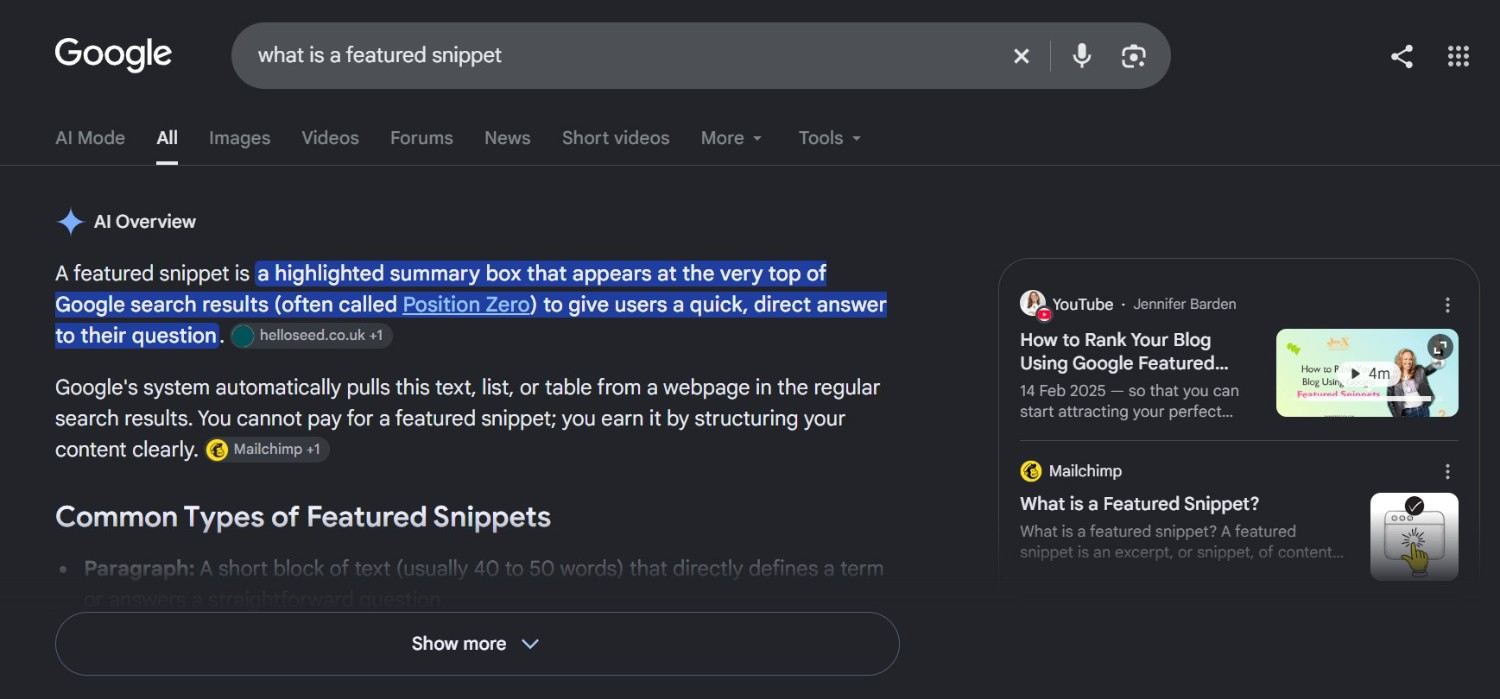
Google explains that featured snippets are special boxes that show the answer text first, and they can also appear inside "People also ask" groups. Google picks them automatically, so you cannot force one. For its AI search features, Google's advice is to focus on unique, helpful content and a page that is easy to use. Nobody can promise that an AI answer will show your page, but clear, honest answers give you the best chance.
Step 8: Track Results and Keep Improving
Set up Google Search Console. It is free and shows how Google sees your site. Verify that you own your site, submit your sitemap, and check that your pages are being indexed.
Watch four numbers
- Impressions
- How many times your page appeared in search results.
- Clicks
- How many people clicked through to your site.
- Click-through rate (CTR)
- Clicks divided by impressions. A low CTR often means your title or description needs work.
- Average position
- Where your page usually appears. Position 1 is the top.
A simple monthly routine
- Find pages with many impressions but few clicks. Rewrite their titles and descriptions.
- Find pages stuck around positions 8 to 20. Improve the content and add internal links to them.
- Update your best pages with fresh prices, facts, and dates.
Google itself says many site owners only need a quick check-up once a month. SEO is slow, and many sites need a few months to see real gains, so watch the trend, not the daily numbers.
When your traffic grows, ads can turn visits into income. Payment setup has its own rules, so read our guide on the AdSense address in Kenya before you apply.
8 SEO Mistakes to Avoid
- Stuffing keywords. Repeating a phrase again and again makes your page hard to read. Write for people.
- Copying other sites. Copied pages add nothing new, so Google has no reason to show them.
- Ignoring phones. If your page is hard to use on a small screen, most visitors will leave.
- Chasing keywords that are too big. A new site cannot beat giant brands on short keywords. Start with long ones.
- Publishing thin pages. A few lines with no real answer will not help anyone.
- Buying links or reviews. It may work for a week and hurt you for a year.
- Forgetting old pages. Prices and facts change. Stale pages lose trust.
- Never checking the numbers. Without Search Console, you are guessing.
What Does SEO Cost in Kenya?
You can start for almost nothing. Use this simple guide, and always ask for a written quote before you pay.
| Item | Typical cost | What to know |
|---|---|---|
| Search Console and Google Business Profile | Ksh 0 | Free tools from Google. Set them up in week one. |
| A .co.ke domain name | From about Ksh 999 | Some registrars advertise this price. Renewal prices can be higher, so read the small print. |
| Web hosting | From about Ksh 420 a month plus VAT | Starter plans cost less and faster plans cost more. Speed helps your visitors and your sales. |
| A small business website | Often quoted from about Ksh 12,000 | Custom online shops can cost well over Ksh 100,000, depending on the features. |
| Your own time | 3 to 5 hours a week | This is the biggest cost. Writing helpful pages takes real effort. |
A Nairobi laptop seller gets 1,000 visitors a month from Google. If 2 in every 100 visitors send a WhatsApp message, that is 20 chats. If 1 in 4 chats becomes a sale, that is 5 sales. With Ksh 4,000 profit on each laptop, SEO brings in Ksh 20,000 a month. Double the visitors and the profit doubles too. Your numbers will be different, but the idea is the same.
If you hire help
- Ask to see real work and real results from Kenyan clients.
- Ask for a written plan and a monthly report you can understand.
- Walk away from anyone who guarantees the number one spot. Google's own guide says no one can promise that.
- Do not pay for "submit to 1,000 search engines". Google is the one that matters here.
Many bad offers share the same warning signs, such as big promises and pressure to pay fast. Our online job scams red flags checklist shows the common ones.
Your 30-Day SEO Action Plan
Do not try to do everything at once. Follow this simple plan, one week at a time.
- Week 1: Set up. Add your site to Search Console. Create your Google Business Profile. Check that HTTPS works and that you have a sitemap. Write down ten customer questions.
- Week 2: Publish. Write two helpful pages that answer long keywords. Tune the titles, descriptions, and image alt text.
- Week 3: Speed up. Compress images, delete unused plugins, and test on a real phone. Add internal links between your pages. Ask five happy customers for reviews.
- Week 4: Build trust. Earn two or three honest links, such as a guest post or a partner listing. Add an FAQ to your best page. Check your Search Console numbers and plan next month.
Frequently Asked Questions About Ranking on Google in Kenya
How long does it take to rank on Google in Kenya?
Most new pages need a few months to show real results, and hard keywords can take longer. Local searches and long, specific keywords often move faster. Nobody can promise a date, so track your progress in Google Search Console every month.
How much does SEO cost in Kenya?
You can start for Ksh 0 with free Google tools. A domain and hosting can start at a few thousand shillings a year, and a small business website is often quoted from about Ksh 12,000. Paid SEO help varies, so ask for a written plan and compare quotes.
Can I rank on Google in Kenya without paying for ads?
Yes. Organic rankings are free. You pay with time and effort instead of money: you research keywords, write helpful pages, speed up your site, and earn trust over time. Ads can bring quick visits, but SEO builds traffic that stays.
Do I need a .co.ke domain to rank in Kenya?
No. A .co.ke domain is a clear Kenyan signal and looks local to visitors, but a .com can also rank in Kenya if your content, Google Business Profile, and location details show who you serve.
What is a featured snippet?
A featured snippet is a short answer box at the top of Google's results. Google picks the text from a web page that answers the question best. You cannot pay for it, but clear question headings and short, direct answers can help.
What is AEO?
AEO means answer engine optimization. It is the work of making your page easy for featured snippets, voice assistants, and AI tools to understand and quote. Give direct answers, use lists and tables, add an FAQ section, and show who wrote the page.
Should I write in English or Swahili?
Write in the language your readers use when they search. Many Kenyans search in English, but some prefer Swahili or a mix of both. Test both in Google autocomplete, and never use poor machine translation.
How do I show up on Google Maps in Kenya?
Create and verify a free Google Business Profile with your real business name, category, address or service area, phone number, and opening hours. Add photos, ask for honest reviews, and keep your details the same everywhere online.
Does page speed help me rank on Google?
Speed is part of page experience, and Google measures it with Core Web Vitals. It will not beat helpful content by itself, but slow pages lose visitors. Aim for a Largest Contentful Paint under 2.5 seconds, an Interaction to Next Paint under 200 milliseconds, and a Cumulative Layout Shift under 0.1.
Can I do SEO myself?
Yes. Most small sites can handle the basics alone: keywords, helpful pages, titles, speed, and a Google Business Profile. Hire help when you need technical fixes, a big site move, or you simply have no time.
Key Takeaways and Next Steps
- Google handles the vast majority of searches in Kenya, so it is worth your effort.
- Pick long, specific keywords that match what your reader wants.
- Write helpful pages with direct answers, real examples, and prices in Ksh.
- Make your site fast on phones, and set up Google Business Profile if you serve a local area.
- Earn links honestly, track your results monthly, and keep improving.
Now you know how to rank on Google in Kenya, and you have a plan to follow. Start with week one today. A small step done this week beats a perfect plan you never begin.
Want a fast, SEO-ready website built for Kenyan visitors? Message us on WhatsApp at 0714 701 814 and tell us what you need.
This guide is for education. Google changes how it works from time to time, and prices in Kenya change too, so check the sources linked above before you make big decisions.